From a cancelled identity card in Munich to a family spread across continents.”
Who We Are
We are the descendants of German woodsmen from the Black Forest, Norwegian fishermen from the fjords of Vest-Agder, Irish immigrants in the tenements of Brooklyn, Russian nobility from Tula Province, Ukrainian families displaced by war, and Polish villagers from the borderlands of empires. Our ancestors survived revolutions, two world wars, concentration camps, forced labor, displacement, and ocean crossings — and built new lives in America and Australia.
This document is the family’s source of truth: everything we know, where it comes from, and what we still hope to discover.
The Family at a Glance
Andrew’s brother: Matthew Alexander Leonenko (b. 1987) •
Wife: Stephanie Halifa Ragman •
Son: Greyson Leonenko (b. 2023)
Aunt: Anna Leonenko Wittke (b. 1954)
Greyson Leonenko’s Heritage
Part IThe German Branch
The Haas Family of Forbach, Black Forest (c. 1650 – present)
Andrew’s mother’s father’s line
The deepest roots in our family tree reach into the village of Forbach, nestled in the northern Black Forest of Baden, Germany. Here, in the hills above the Murg River, our ancestors lived for over two hundred years.
The Founding Families of Forbach
The earliest traceable ancestor is [Karcher] (b. c. 1650, Forbach; d. 1712), who married Anna Kraemer (b. 29 Apr 1654; d. 10 Jan 1716) on 22 November 1676. Their descendants married into the other old Forbach families — the Wunsches, the Grossmanns, the Schillingers, the Goetzes — weaving a web of relationships across the village over generations.
The Karcher-Wunsch Line:
Johannes Michael Wunsch was the son of Johann Martin Wunsch (b. 11 Nov 1719; d. 1794) and Anna Maria Grossmann (b. 10 May 1716), both of Forbach.
The Haas Line from Friedenweiler:
Johannes Nepomuk and Maria Elisabetha’s children (all born in Forbach):
| Name | Born | Died | Notes |
|---|---|---|---|
| Johann Martin Valentin Haas | 30 Sep 1789 | 24 Dec 1868, Forbach | |
| Franz Anton Haas | 12 Sep 1792 | 14 Aug 1884 | |
| Philipp Haas | 25 Jul 1796 | — | |
| Maria Franziska Haas | 7 Sep 1799 | — | |
| Aloysius Haas | 13 Nov 1801 | — | Direct ancestor |
| Vinzenz Josef Haas | 19 Jul 1805 | 1 Sep 1865, Forbach | |
| Leonardus Haas | 20 Nov 1809 | 6 Sep 1811 | Died as infant |
The Wunsch-Haas Marriage
Aloysius Haas (b. 1801, Forbach) married Maria Anna Wunsch (b. 1792, Forbach), joining the two great Forbach families. Their children:
| Name | Born | Died | Emigrated? |
|---|---|---|---|
| Leopoldina Haas | 13 Aug 1830, Forbach | — | — |
| Ludwig Haas | 3 Feb 1832, Forbach | 20 Jun 1910, Brooklyn, NY | Yes — to New York |
| Elizabeth Haas | 28 Jul 1833, Forbach | 25 Apr 1912, St. Jacobs, IL | Yes — to Illinois |
| Maximilian A.F. Haas | 20 Aug 1834, Forbach | — | Son emigrated |
Maximilian A.F. Haas married Maria Anna Kraemer (b. 28 Sep 1833, Forbach) on 24 November 1859.
Alois Haas: The Emigrant (1862–1931)
Maximilian and Maria Anna’s son Alois Haas was born 20 July 1862 in Forbach. Around 1881, at age nineteen, he sailed for America.
In New York, on 28 January 1894, at the Church of St. Boniface (2nd Avenue and 47th Street, Manhattan), he married Anna Maria Nebel (b. 11 April 1873; d. 29 June 1962). He became a naturalized US citizen on 23 September 1918. He died 4 April 1931 in the Bronx.
Anna Maria Nebel’s family (from Bavaria): Father Balthasar Nebel (b. 14 Apr 1843, Miltenberg; arrived USA 1883), mother Elisabeth Oberle (b. Feb 1842; d. 14 Jul 1901, New York), grandfather Jacob Nebel (b. 6 Aug 1808, Ebersbach; d. 15 Oct 1842).
The German Line to Long Island
2026 Research Findings
The 1940 US Federal Census confirms Aloysius C. Haas, age 25, living in Sunnyside, Queens, New York with his wife Dorothy. Given that the family patriarch was named Aloysius (b. 1801) and the family had deep roots in Queens, this is very likely a direct descendant — the name “Aloysius” persisting across four generations from the Black Forest to New York. The Baden Emigration Index (Collection 4610) on Ancestry catalogues departures from the Baden region where Forbach is located, and may contain Alois Haas’s original emigration record from the 1880s. St. Boniface Church in Queens, where the Haas family likely worshipped, was demolished in 1950 — parish records may have been transferred to the Archdiocese of New York.
The Nebel family connection has deepened: a Heinrich Anton Nebel from Soden bei Miltenberg died in Queens, confirming the Nebels settled in the same New York borough as the Haases. The Wunsch family (Maria Anna Wunsch, who married Aloysius Haas in 1801) has also been traced to the Murg valley in Baden — the same valley where Forbach sits. All the founding families — Haas, Wunsch, Karcher, Kraemer — lived within walking distance of each other.
Heinrich Anton Nebel’s grandson Adalbert Nebel had a daughter named Jane Anne Nebel (1934–2013), who married Jim Henson — the creator of The Muppets, Sesame Street, and Fraggle Rock. Jane Nebel was Jim Henson’s first collaborator, performing the original Kermit-like puppet on Sam and Friends in 1955, and co-founded Muppets, Inc. with him. If Andrew’s Nebel ancestors connect to Heinrich Anton’s line — both families came from the same region and settled in Queens — then Jane Nebel Henson would be a distant relative on Andrew’s mother’s side. This connection requires further genealogical confirmation but the geographic and chronological overlap is striking.
The Beenders Discovery: A Path to German Citizenship
The most significant discovery of the 2026 research came not from the Haas line but from George’s wife’s family — the Beenders family of Ostfriesland, Germany.
Reinhard Eden Beenders — The Baker from Westlintel
Reinhard Eden Beenders was born 11 February 1883 in Westlintel, Ostfriesland, Germany — a small village in the flat marshlands of northwestern Germany, near the Dutch border. He was a baker by trade, with fair complexion, blue eyes, blonde hair, standing five feet four inches and weighing 165 pounds.
On 10 February 1906 — one day before his 23rd birthday — he married Margarete Weichmann (b. 20 Oct 1883, Bremen) in Bremen, Germany. Their first child, Anna, was born five months later in July 1906 in Germany. A second child, Reinhard Jr., followed in July 1909, also born in Germany.
In the summer of 1914 — just weeks before the outbreak of World War I — the Beenders family left Germany forever. Departing from Malmö, Sweden aboard the vessel SS United States, they arrived in New York on 18 August 1914. Anna was eight years old. Two more children were born in America: Edine (1915) and Henriette (1917).
In August 1922, Margarete took all four children back to Germany to visit family. The S.S. Seydlitz passenger manifest, departing Bremen on 5 August 1922, shows the distinction that seals the case: the immigration officer explicitly noted that Edine and Henriette were “BORN [date] NEW YORK U.S.A.” — because they were American-born children. Anna and Reinhard have no such notation — because they were born in Germany, not America. Margarete’s nearest relative in Europe was listed as her brother Friedrich Wichmann, Glogauerstr. 27, Bremen — confirming her maiden name as Wichmann/Weichmann and the Bremen origin.
The family settled in Brooklyn, eventually residing at 52 Fane Court. Reinhardt worked as a baker. He filed his Declaration of Intention on 5 November 1930 and became a naturalized American citizen on 12 September 1933, at age 50, in the U.S. District Court, Eastern District of New York, Brooklyn (Certificate No. 3734749, Petition No. 181867).
Anna’s Lost Citizenship — and a Path to Reclaim It
Anna M. Beenders was a German citizen by birth — born in Germany to two German parents. She grew up speaking German in the home. The 1930 U.S. Census, enumerated by Garrett E. Princhik on 21 May 1930 at 9 Ira Court, Brooklyn, confirms every detail: birthplace Germany, father’s birthplace Germany, mother’s birthplace Germany, language spoken German, immigration year 1914, naturalization status “Al” (Alien). She had not become a US citizen.
On 3 February 1927, Anna married George W. Haas, an American citizen. Under Section 17(6) of the RuStAG (the 1913 German citizenship law), a German woman who married a foreigner automatically lost her German citizenship. But the American Cable Act of 1922 had ended the practice of wives automatically gaining their husband’s citizenship. Anna fell into a cruel legal gap — stripped of her German nationality by one country, denied automatic American nationality by another. She lived as a stateless alien in Brooklyn for the rest of her short life.
Ten months after the marriage, on 2 December 1927, their first son was born — Eugene George Haas (known as “George” in childhood, later going by Eugene). Under the pre-1975 German law, citizenship could only pass through fathers to children born in wedlock. Even if Anna had somehow retained her German citizenship, Eugene would have been denied it because his mother — not his father — was the German parent. He was excluded purely because of gender discrimination.
Anna never naturalized. She died on 28 May 1940, at age 33 or 34, in Brooklyn. A brief obituary in the Brooklyn newspaper read:
“HAAS — ANNA M., of 9 Ira Court, Brooklyn, wife of George Haas, May 28. Survived by three children, George, Walter and Margaret. Funeral services at Byrnes Funeral Home, 2382 Gerrittsen Ave., Friday, 8:30 p.m. Funeral Saturday, 10:30 a.m.”
She was buried somewhere in Brooklyn. Her three children — George/Eugene (12), Walter (7), and Margaret (4) — were left motherless.
Section 5 StAG — The 2021 Remedy
In August 2021, Germany enacted Section 5 of the Nationality Act (StAG), creating a ten-year window for descendants affected by gender discrimination in citizenship transmission to reclaim German citizenship by simple declaration. No German language skills required. No residency requirement. Dual citizenship fully allowed.
The evidence chain for the Leonenko family is now documented:
| Date | Event | Legal Effect |
|---|---|---|
| 11 Feb 1883 | Reinhard Eden Beenders born, Westlintel, Germany | German citizen by birth |
| Jul 1906 | Anna M. Beenders born in Germany | German citizen by jus sanguinis |
| 18 Aug 1914 | Beenders family arrives in New York | Anna still a German citizen, age 8 |
| 3 Feb 1927 | Anna marries George W. Haas (American) | Anna loses German citizenship under §17(6) RuStAG |
| 2 Dec 1927 | Eugene George Haas born, Brooklyn | Denied German citizenship — mother lost hers; pre-1975 law only passed through fathers |
| 12 Sep 1933 | Reinhardt naturalized as US citizen | No effect on Anna — she was already married |
| 28 May 1940 | Anna dies, Brooklyn, age 33 | Never naturalized — died stateless |
| 24 Apr 1955 | Patricia Ann Haas born (Andrew’s mother) | Would have been German if not for the sexist law |
| 9 Sep 1988 | Andrew Nicholas Leonenko born | Same — denied through gender discrimination |
| 20 Aug 2021 | Section 5 StAG enacted | Descendants may declare German citizenship |
| 19 Aug 2031 | Deadline for declaration | Must be received by the BVA by this date |
- Reinhardt’s Declaration of Intention (1930) — sworn federal court document listing Anna born in Germany, Reinhardt born Westlintel, married Bremen, arrived 1914
- Naturalization Certificate No. 3734749 (1933) — Reinhardt naturalized 12 Sep 1933 at U.S. District Court, Brooklyn
- 1930 U.S. Census — Anna: born Germany, alien, German-speaking, parents born Germany, immigrated 1914
- 1940 U.S. Census — Haas household at Ira Court: George (37), Anna (35), George/Eugene (11), Walter (7), Margaret (4)
- Brooklyn Newspaper Obituary (May 1940) — confirms Anna’s death, address, husband, and three children
Part IIThe Norwegian Branch
The Solberg Family of Vest-Agder (c. 1724 – present)
Andrew’s mother’s mother’s line
On the other side of Andrew’s mother’s family, the story begins along the rocky southern coast of Norway, in the region of Vest-Agder, among the fjords and fishing villages near Flekkefjord.
Steve Siversten Solberg first emigrated around 1875, at just fifteen. He returned to Norway, then departed again from Christiania (Oslo), arriving in New York on 22 August 1904. He settled in Brooklyn. His son Albert Oden Solberg was born in Oslo in 1905 and brought to America at age six.
2026 Research Findings
Find a Grave records show Maren Anette Solberg (born 10 October 1864; died 1 August 1941) and Pedora Solberg (d. 1941) buried in adjacent plots — FOR-9-A-34AB and FOR-9-A-34AA — at Cedar Grove Cemetery, Queens, New York. Maren Anette’s birth year (1864) places her in the same generation as Steve (b. 1860) — almost certainly his sister. That both Solbergs died in the same year and are buried side by side in Queens, where Albert and Harriet raised their family, confirms the Norwegian branch put down deep roots in that borough. Ancestry shows 5 records for Maren Anette Solberg, and immigration data suggests she emigrated to the United States between 1900 and 1910 — around the same time Steve made his final crossing in 1904.
The Loge farm name has been confirmed as Farm #71 in Nes Parish, Flekkefjord municipality — a named hill farm in the historic Nes bygd (rural district). In Norwegian naming conventions, farm names functioned as surnames: “Tonnes Jonsen Loge” meant “Tonnes, son of Jon, of the Loge farm.” The Loge farm can be traced in church records and farm censuses back to at least the mid-1700s.
Part IIIThe Irish-American Branch
The Welsh, Kirkman, Wright, and Pfiefer Families
Through Andrew’s maternal grandmother’s mother
Sarah Anna Welch (b. 1892, New York) came from established New York families. Her father Edward Francis Welch Sr. (b. 25 Nov 1862, Brooklyn) was the son of James Welsh (b. 1820, New York) and Alice Kirkman (b. c. 1820) — the Welsh surname strongly suggests Irish ancestry from the great wave of immigration to Brooklyn in the 1840s–50s.
Her mother Harriett Amy Wright (b. 9 Aug 1870; d. 7 Jun 1944, Queens) was the daughter of William Wright and Henrietta Pfiefer — adding another German thread.
Part IVThe Russian Branch
The Rickman Family: Moscow to Tula to Yugoslavia to Adelaide (1794–1967)
Andrew’s father’s mother’s line — the most dramatic branch
The Imperial Rickmans (1794–1912)
The Rickman family were members of the Russian gentry and civil/military service class, rooted in Tula Province, about 200 km south of Moscow.
The Avtomonov Connection
Anna Vasilievna Avtomonova connects us to the Avtomonov family of Varvarino, near Belev, in Tula Province — and to a distant cousin in Sweden (4th cousin once removed).
Konstantin Rickman: Revolution and Exile
Konstantin had two sons: Georg (Yuri) (b. 1907/1908, Moscow) and Igor (b. 27 January 1909). The family fled Russia during the Revolution and Civil War, eventually reaching Yugoslavia. Konstantin’s last years were spent in DP Camp Ried im Innkreis, Austria — a tuberculosis rehabilitation facility. He died around 1949.
Georg Rickman: Yugoslavia, War, and Displacement
Georg was a White Russian emigre in Yugoslavia. He joined the Russian Protective Corps (Russisches Schutzkorps) during WWII — a unit of anti-communist White Russians under German command. This wartime service would later split his family.
Georg married Irena Renda and they settled in the Banat region of Yugoslavia. Their daughter Sofia L. Rickman was born 17 August 1933 in Kovin.
The CM/1 Application (Arolsen Archives)
| Field | Georg | Irena |
|---|---|---|
| Birth date | 27.6.1908 | 19.4.1908 |
| Birthplace | Moscow | Turkovice, Lublin, Poland |
| Nationality | Nansen/Russian | Nansen/Polish |
| Religion | Orthodox | Orthodox |
| Languages | Russian, Serbian | Polish, Ukrainian, German |
| Desired destination | Argentina, Canada, USA | |
| Classification | “Alter Emigrant” | |
| Decision | APPROVED |
The Family Split (March–September 1950)
This is one of the central stories of our family history. Georg’s Russian Protective Corps service made him ineligible for US immigration under the Displaced Persons Act, Section 13. Australia accepted former Axis-aligned emigres.
- 17 March 1950: Georg and Irena departed Munich for Australia.
- 2 September 1950: Sofia (age 17) departed Bremerhaven alone aboard the USNS General W. C. Langfitt, arriving in New York on 14 September 1950.
Sofia was likely sponsored by the Tolstoy Foundation — founded by Countess Alexandra Tolstoy, it settled over 42,000 Russian refugees in America.
Georg’s Second Family — The Solodky Discovery
Helene Rickmann, née SOLODKY (b. 21 May 1921, Aleximas; d. 2015). The Arolsen Archives reveal her entire family:
| Person | Born | Place | Nationality |
|---|---|---|---|
| Waldemar Solodky (father) | 09/05/1898 | — | Russian |
| Olga Solodky née SKORODUMOWA (mother) | 07/11/1897 | St. Petersburg | Russian |
| Ivan Solodky (brother) | 07/11/1922 | — | Russian |
| Paul Solodky (brother) | 02/25/1925 | — | Russian |
Olga’s maiden name SKORODUMOWA raises a striking question: General Mikhail Skorodumov (1892–1963) was the founder of the Russian Protective Corps in Belgrade — the very same unit Georg served in. Was Olga related to the General?
Wladimir Rickmann (b. 12 July 1941, Belgrade) emigrated in 1949 with Helene. Evidence strongly suggests he became Georg’s son in America — Andrew’s half-great-uncle.
Natalia Filimonoff — Russian Nobility Confirmed
Natalia Rickmann née FILIMONOFF (b. 1890, Kaluga) is almost certainly Konstantin’s wife — Andrew’s great-great-grandmother. The Filimonov family was confirmed Russian nobility, registered in the Noble Genealogical Book of Moscow Province, with four documented noble branches traced to the 13th century.
Part VThe Polish-Ukrainian Borderlands
Irena Renda and the Podkowinski Connection (1908–1982)
Andrew’s paternal grandmother’s mother
Irena Renda was born 19 April 1908 in Turkowice, Hrubieszow County, in what is now eastern Poland. In 1908 it was under Russian Imperial administration — a historically Ukrainian village with an Orthodox monastery supported by Tsar Nicholas II. On 10 March 1944, as part of the same military operation as the Sahryń massacre, Polish Home Army (AK) and Peasant Battalions (BCh) units attacked Turkowice: 80 Ukrainian villagers were murdered and 150 houses destroyed — a “reprisal” for the Massacres of Poles in Volhynia. Other villages attacked that day included Sahryń, Szychowice, Modryń, and Terebyń. In 1947, the remaining Ukrainian population was deported during Operation Vistula — a forced relocation of approximately 141,000–150,000 Ukrainians, Lemkos, and Rusyns from southeastern Poland, carried out by six divisions of the Polish army beginning 28 April 1947.
Irena’s father is recorded only as “/Renda/” — no first name. The most likely way to find it would be to request the 1908 birth record from the Lublin State Archive, Chelm branch. The surname Renda is primarily Italian (from Calabria and Sicily), with approximately 14,563 bearers worldwide — but 180 people in Poland and 44 in Ukraine carry the name, possibly descended from Italian artisans or settlers who came to Galicia during the Austrian period. The name does not appear in the Dictionary of Lemko Surnames.
Before Georg, Irena was married to a Podkowinski. Their sons Jurij (b. 1932, Volhynia) and Eugen (b. 1934) vanish after the DP period. An Arthur Podkowinski in Victoria, Australia may be a descendant. The Arolsen Archives contain records for multiple Josef Podkowinski entries at Majdanek concentration camp, though the exact connection remains unconfirmed. The State Museum at Majdanek maintains a searchable database of 56,000 prisoners.
2026 Research Findings — The Hrysak Surname
Gertrude’s maiden name Hrysak appears in the Dictionary of Lemko Surnames (based on the 1787 Austrian Cadastral Census) in four villages: Hańczowa, Klymkiwka, Radocyna (all in Gorlice County), and Kostariwci (listed as “Hryszak”) — all in the heart of the Lemko region in the Low Beskid mountains. This places the Hrysak family squarely in the historic Lemko heartland, though the specific village “Shelechiw” near Tarnow mentioned in the Arolsen records has not been independently located in any online gazetteer.
Find a Grave reveals three distinct clusters of Hrysak burials. In Manitoba, Canada, a large family group — founded by patriarch Prokip Hrycak — includes Wasyl (1889–1973), Mary (1890–1968), John (1909–1978), and others, buried at Ukrainian Catholic and Orthodox cemeteries near Oakburn, representing an earlier immigration wave from the Lemko region. In Vienna, Austria, three Hrysaks — Franz (d. 27 March 1946), Julie (d. 11 February 1959), and Philomena (d. 9 October 1953) — are buried at Friedhof Baumgarten. Franz’s death on 27 March 1946, less than a year after liberation, strongly suggests a displaced person or forced laborer who died in Austria — the same country where Gertrude’s siblings were documented in forced labor camps. If Franz and Julie were Gertrude’s parents, the Friedhöfe Wien burial search could provide their birth dates and exact grave locations. In Philadelphia, Pennsylvania, a Stanley Hrysak died in 1965 at age 76 (b. ~1889) — an American Hrysak whose age places him in the same generation as the Manitoba and Vienna clusters, suggesting yet another branch of the family that settled in the Eastern US.
Part VIThe Leonenko-Petrenko Line
From Vinnytsia to Long Island (1890s–1995)
Andrew’s paternal grandfather’s line
Sergej and Odarka
Sergej Leonenko (b. ~1895) married Odarka Petrenko (b. 17 September 1891). The GEDCOM listed them as “Serges” and “Dora” — but the DP card reveals the proper Ukrainian forms: Sergej and Odarka (a Ukrainian name from Greek Theodora). They were from the Vinnytsia region of central-western Ukraine. The surname Leonenko is extremely rare in the United States — only 14 bearers nationwide (per Forebears.io) — meaning virtually any American Leonenko record is likely connected to this family.
Sasha “Alexander” Leonenko Sr. (1920–1995)
Born 5 July 1920 in Vinnytsia (Winniza), Ukraine — NOT “Russia” as previously believed.
The DP Card — The Rosetta Stone of Our Family
Sasha’s A.E.F. D.P. Registration Card (DocID 68019560, Registration No. 081183) has been found and read in the Arolsen Archives. Dated 18 June 1947, it is the single most important document in our family research.
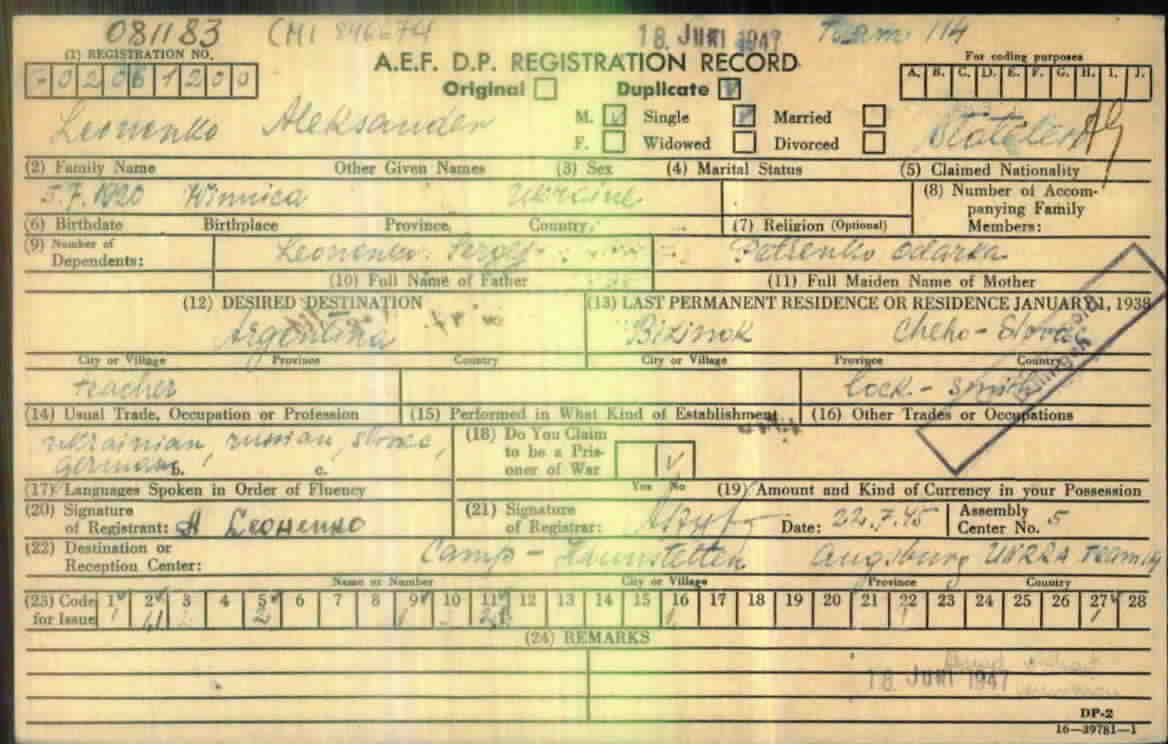
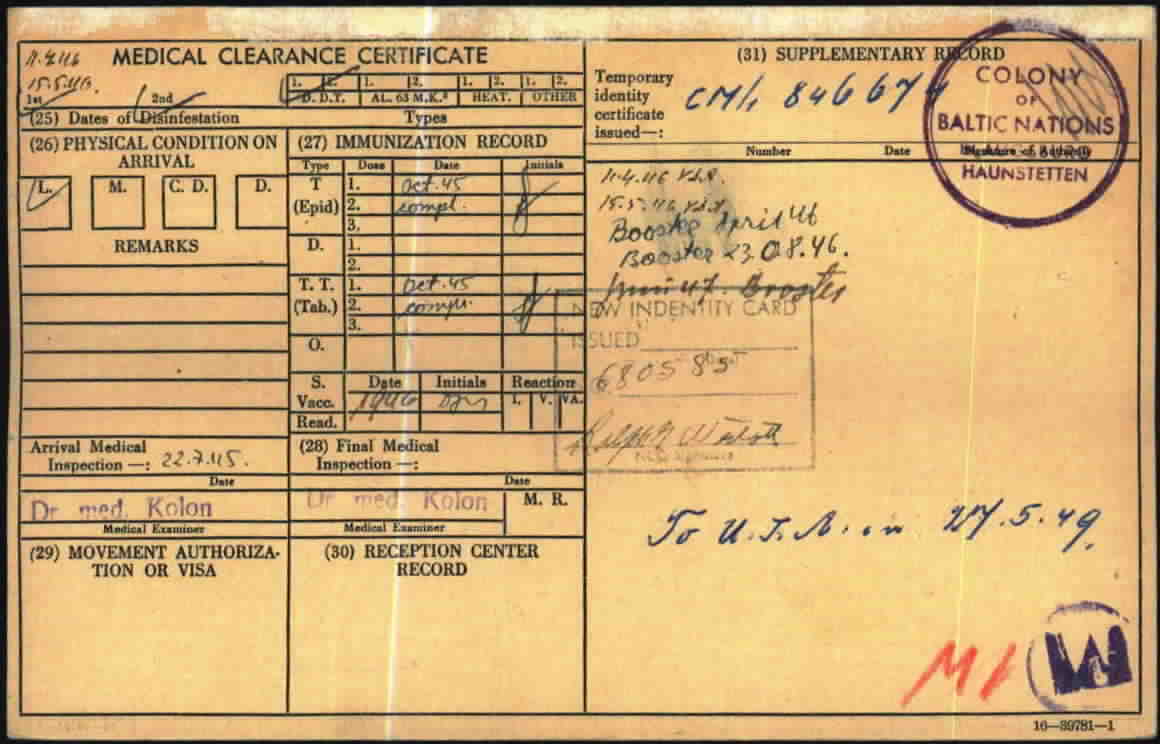
| Field | What the Card Says |
|---|---|
| Full Name | Leonenko, Aleksander |
| Birthdate | 5.7.1920 |
| Birthplace | Winniza (Vinnytsia), Ukraine |
| Nationality | Stateless |
| Marital Status | Single (as of 1947) |
| Father’s Full Name | Leonenko, Sergej |
| Mother’s Full Maiden Name | Petrenko, Odarka |
| Desired Destination | Argentina |
| Last Residence Jan 1, 1939 | Bisinok, Czecho-Slovakia |
| Occupation | Teacher |
| Other Trades | Lock-smith |
| Languages (in order) | Ukrainian, Russian, Slovak, German |
| Camp | Camp Haunstetten, Augsburg — “Colony of Baltic Nations” |
| Arrival at Camp | 22 July 1945 |
| Emigration | “To U.S.A. in 27.5.49” |
| Signature | A. Leonenko (in his own hand) |
- He was Ukrainian, not Russian. Ukrainian was his first language. Born in Vinnytsia.
- His mother’s name was ODARKA — “Dora” was a nickname.
- He lived in Czechoslovakia in 1939 — explaining his fluent Slovak.
- He was a teacher — not the carpenter he later became in America.
- He originally wanted to go to Argentina — something changed.
- He arrived at camp on 22 July 1945 — six weeks after the war ended.
- He emigrated to the USA on 27 May 1949.
The Voyage to America (May–June 1949)
The date “27.5.49” on Sasha’s DP card most likely records his departure from Camp Haunstetten, not from Germany itself. The standard IRO processing route was: DP camp → Camp Grohn (the IRO staging center in Bremen, where émigrés received vaccinations, medical exams, and two-day orientation sessions about American life) → train to Bremerhaven port → board ship. This transit typically took several days.
The most likely vessel was the USAT General W. G. Haan (AP-158), a military transport ship that was scheduled to depart Bremerhaven on 31 May 1949 bound for New York with displaced persons. The Atlantic crossing typically took 8–10 days, placing arrival around early June 1949.
Emigrating alongside Sasha was Gertrude Leonenko, née HRYSAK (b. 7 July 1925, Weyer) — apparently his wife. She came from a Lemko Ukrainian family from Shelechiw/Tarnow in Galicia. What happened to their marriage before he married Sofia in October 1951 remains a mystery.
He found work as a carpenter and married Sofia Rickman on 18 October 1951 in Brooklyn.
Died: 29 May 1995, St. Petersburg, Florida
Buried: Royal Palm South Cemetery, St. Petersburg, Pinellas County, Florida (Find a Grave Memorial #12013283). In 2015, a visitor identified only as “R.C.” left a virtual flower with the inscription “Vecnaja Pamjat’!” (“Вечная Память” — “Eternal Memory” in Russian/Ukrainian transliteration) — confirming that someone in the Slavic community still remembered him twenty years after his death. His US Social Security records (Applications and Claims Index 1936–2007, Florida Death Index, SSDI) are available on Ancestry and may reveal his immigration details.
Note: Find a Grave records his birth as 5 July 1920, while his DP card states 29 August 1920. The discrepancy may reflect the difference between the Julian calendar (still used in parts of Ukraine at the time) and the Gregorian calendar, or a simple clerical variation across decades of documents.
Nickolay “Filimonowitsch” Leonenko (1925–2001)
A second Leonenko has emerged from the archives. The Arolsen Archives “Index to Tracing and Documentation Files” (1947) contains an entry for “Filimonowitsch Leonenko”, identified as Nikolai Leonenko, born 1 June 1925 (Case #2165883, Catalog 6.3.3.2, Reference #117536207). The patronymic “Filimonowitsch” is a German transliteration of the Slavic Filimonovich, meaning his father was Filimon Leonenko.
Since Sasha’s father was Sergej, Nickolay was not Sasha’s brother — but quite possibly a cousin from the same Vinnytsia-region Leonenko clan. Both men were Ukrainian displaced persons cataloged in the Arolsen tracing system in 1947, both in their twenties, both adrift in postwar Europe. That two Leonenkos from the same generation ended up in the same DP bureaucracy strongly suggests a shared origin — perhaps the same village or extended family network.
After the war, Nickolay emigrated to Canada rather than the United States. Canadian phone directories place him at 309 W Killaly Street, Port Colborne, Ontario (postal code L3K 3M7) continuously from 1995 to 2002. A Ukrainian Orthodox church stands at 55 Charlotte Street, Port Colborne (phone: 905-834-3184) under the Eastern Eparchy — almost certainly Nickolay’s parish, and a potential source of marriage, baptism, and funeral records.
He died in 2001 and was buried at Meadowvale Cemetery, Brampton, Ontario (Section 13, Lot 718) alongside Gertrude Leonenko née Hrysak — Sasha’s first wife, who had separated from Sasha before 1951 and apparently remarried Nickolay. That Gertrude went from one displaced Leonenko to another suggests the Ukrainian DP community in the late 1940s was small and tightly interconnected. Strikingly, Gertrude and Sasha both died in 1995 — she in Canada, he in Florida.
Living Leonenkos in Ontario: Canada411 currently lists two Leonenko households: Fred Leonenko at 84 Prouse, Brampton (the same city as Meadowvale Cemetery) and Paul Leonenko at 62 Park, Georgetown (nearby in Halton Hills). These are very likely Nickolay and Gertrude’s descendants or close relatives.
An Earlier American Leonenko: Find a Grave also records a Nicolay “Nick” Leonenko (6 May 1890 – 4 June 1956) buried at St. Anthony’s Cemetery in Blaine, Belmont County, Ohio — a coal-mining town with a large Ukrainian/Slavic immigrant community. His wife was Anna Magres Kominsky. Born in 1890, he was roughly the same generation as Sergej (~1895). Whether this Ohio Leonenko is related to the Vinnytsia Leonenkos remains unconfirmed, but the name, era, and Ukrainian context make it plausible.
Part VIIThe Convergence
Long Island, 1950–Present
Sofia Arrives in America (1950)
Sofia Rickman arrived in New York on 14 September 1950 aboard the USNS General W. C. Langfitt — a seventeen-year-old girl, alone, carrying a Nansen passport. She had left her parents (who went to Australia) and crossed the Atlantic from Bremerhaven.
The Marriage (1951)
On 18 October 1951, in Brooklyn, Sofia Rickman married Sasha Leonenko — two displaced children, both stateless, both survivors, both building new lives with nothing but their hands and their will.
| Name | Born | Notes |
|---|---|---|
| Anna Leonenko | 13 Jul 1954 | Andrew’s aunt |
| Alexander Heller Leonenko Jr. | 28 May 1957, Patchogue | Andrew’s father |
Alexander Jr. married Patricia Ann Haas. They raised their family in Garden City, Long Island. Their sons: Matthew Alexander Leonenko (b. 1987) and Andrew Nicholas Leonenko (b. 1988, Mineola). Alexander passed away on 5 September 2014. He was 57. Patricia later moved to Freeport, NY.
The Next Generation
Andrew married Stephanie Halifa Ragman. Their son Greyson Leonenko (b. 2023) carries the Leonenko name into the next generation — a name that began in Vinnytsia, survived displacement across three continents, and now continues on Long Island, where it arrived over seventy years ago.
Sofia remarried in 1988 to Paul Edwin Frost. She died on 5 November 2010, age 77, and was buried at Calverton National Cemetery, Long Island.
Part VIIIThe Guyanese-Chinese Branch
The Ragman and Choo-Yick Families: From India and China to the Caribbean
Through Andrew’s wife, Stephanie — Greyson’s mother’s line
With the marriage of Andrew and Stephanie Halifa Ragman (b. 23 March 1994) and the birth of their son Greyson Leonenko (b. 2023), the Leonenko family story gained two entirely new threads: Indo-Guyanese Muslim and Chinese-Guyanese heritage, both rooted in the colonial history of Guyana.
The Ragman Family — Indo-Guyanese Muslim Heritage
Stephanie’s father, Sheik Abdul Bashir Ragman (1950–2018), was born 27 October 1950 at Plantation Skeldon, Berbice, Guyana and died in 2018. His father was Abdul Ragman (properly Abdul Rahman) and his mother Naziran (often recorded as “Nazitann”), born 20 May 1922 in Georgetown, Demerara-Mahaica, Guyana, and died 16 February 1991 in Georgetown. Bashir had at least three siblings: Bibi Rahman (b. 11 Jun 1948), Sultan Rahman (b. 13 Aug 1950), and Abdul Rahman Jr. (b. 4 Feb 1954) — all three of whom emigrated to New York on 30 July 1962, traveling under the original family name Rahman rather than the Guyanese colonial spelling “Ragman.”
The surname Ragman is extremely rare worldwide — only approximately 174 bearers globally, with its highest per-capita concentration in Guyana (1 in 108,889). Research confirms it is a colonial anglicization of the Arabic name Rahman (“the Most Compassionate”), one of the 99 Names of Allah. The corruption occurred through oral testimony to British registrars who could not read or write Urdu or Arabic. Documented parallel corruptions in Guyana include Maqdoom → “McDoom,” Khatoon → “Cartoon,” Ramazan → “Ramjohn,” and Rahman → “Rahaman, Rayman, Rahamun.” The leap from Rahman to Ragman fits squarely within this pattern.
The name “Abdul Ragman” follows the exact Islamic structure of “Abdul + [Attribute of God]” — i.e. Abdul Rahman (“Servant of the Most Compassionate”), one of the most common Muslim names in the world. The honorific “Sheik” (Sheikh) and the name “Abdul Bashir” (“Servant of the Bringer of Good News”) further confirm the family’s Islamic heritage. Stephanie’s middle name Halifa is a variant of Khalifa (Arabic: خليفة — “successor, caliph”).
Stephanie’s paternal grandmother’s name was Naziran (b. 20 May 1922, d. 16 Feb 1991) — often rendered as “Nazitann” in family records, a common distortion through oral transmission and colonial phonetics. The name likely derives from the Persian/Urdu Nazir (نظیر — “observer, overseer”) with the feminine suffix -an, or from Naz (Persian: “pride, grace, elegance”). She was recorded with no surname, which was not unusual: before British colonization, surnames were not universal in India, and Muslim women from North India commonly used only a given name, sometimes with honorifics like Bibi (“lady”) or Khatoon (“lady of rank”). Her parents remain unknown. Ancestry records place her in Georgetown, Demerara-Mahaica — not Berbice — suggesting either she or the Ragman family may have moved between regions.
The Indenture System: India to the Caribbean (1838–1917)
Stephanie’s paternal ancestors were part of the great wave of Indian indentured laborers who came to British Guiana beginning in 1838. The first ships — the Whitby and the Hesperus — arrived in Berbice on 5–6 May 1838, landing 396 laborers. The first batch aboard the Whitby included 94 Muslims.
Over the next 79 years, 245 ships made 534 voyages, bringing 238,909 Indians to British Guiana. Ninety-five percent departed from the Port of Calcutta. The laborers came primarily from Uttar Pradesh (62%) and Bihar (20%) — especially the Bhojpur and Awadh regions. Approximately 15% were Muslim, bringing with them the Urdu language, Persian cuisine, Ghazal recitation, and Quranic scholarship.
The Ragman ancestors most likely originated from cities like Lucknow, Ghazipur, Allahabad, Agra, or Gorakhpur in present-day Uttar Pradesh. They crossed the Kaala Paani (“Black Water”) — an ocean crossing considered a profound cultural transgression by many Hindus — and were assigned to sugar plantations along the Berbice coast.
The Berbice region where the Ragmans settled had significant Muslim communities. The #78/79 Mosque in upper Corentyne (established 1863) is one of the earliest in the country. Archival records document an “Abdool Rahaman from Springlands, Corentyne Berbice” — the Rahman name present in the exact region where the Ragman family likely lived. Today, Guyana is 6.77% Muslim, and the country’s current president, Irfaan Ali, is its first Muslim head of state.
2026 Update — The Rahman Family in New York: Database searches reveal a Bibi F. Rahman living in Floral Park, Long Island, New York — the same community where Guyanese-American families are concentrated. The household includes a member named “Sheik”, matching the family’s Islamic naming pattern (Bashir’s full name was Sheik Abdul Bashir). This places Stephanie’s aunt firmly on Long Island. “Plantation Skeldon” — Bashir’s birthplace — is confirmed to be Plantation Skeldon, a major sugar estate on the Corentyne coast of Berbice. Skeldon was one of the largest and most historically significant plantations in the colony, with substantial Indian indentured labor populations. The “Sheldon” spelling was a phonetic variant that persisted through oral family records.
The 1962 arrival of Bibi, Sultan, and Abdul Jr. was almost certainly by air, not by ship — regular passenger ship service between the Caribbean and New York had largely ended by the early 1950s. The family may have flown from Atkinson Field (now Cheddi Jagan International Airport) to Idlewild Airport (now JFK).
The Rahman Family Lottery: In one of the more extraordinary chapters of the Rahman story, five members of the family won the New York State Lottery, sharing a $5 million prize. The winners included family members using the Rahman name, further confirming the family’s established presence in the New York metropolitan area. Business records also show an S F Party Hall LLC associated with the family — suggesting the Rahmans became involved in the Guyanese-American event and hospitality industry on Long Island.
The Choo-Yick and Chung Families — Chinese-Guyanese Heritage
Stephanie’s mother, Carol Rosemarie Choo-Yick, was born 19 August 1954 at 2 Winkle, New Amsterdam, East Berbice-Corentyne, Guyana. Her father, Kwong Yik Choo-Yick, was born 10 June 1914 in China and died 28 June 1999 in Scarborough, Toronto, Ontario, Canada. He was recorded on Carol’s birth certificate simply as a “Native of China” — adding an East Asian thread to our family tapestry. Her mother, Gwendoline Chung, was born 26 April 1923 in Georgetown, Demerara-Mahaica, Guyana and died 21 February 1975. She was buried in Markham, York Regional Municipality, Ontario, Canada alongside her husband. The shared headstone — inscribed “CHOO” at the top with a cross and Bible — reads: “In Loving Memory of Kwong Yik Choo, June 10, 1914 – June 22, 1998, Beloved Husband of Gwendoline Chung, Apr. 26, 1923 – Feb. 21, 1975. Forever in Our Hearts, Always Remembered.” Carol was only 21 years old when she lost her mother.
Ancestry records reveal his full name: Kwong Yik Choo-Yick. The compound “Choo-Yick” became the family surname in colonial Guyana — a common pattern where British registrars fused a Chinese surname with part of the given name. “Choo” most likely represents 朱 (Zhū), the 17th entry in the Hundred Family Surnames and the imperial surname of the Ming Dynasty. In Hakka dialect, 朱 is pronounced “Chû” — which colonial clerks naturally rendered as “Choo.” “Kwong Yik” (光益, Guāng Yì — “bright benefit”) was his personal name, with “Yick” (益) becoming permanently attached to the surname. His full Chinese name was likely 朱光益 (Zhū Guāng Yì).
Kwong Yik was born in China in 1914 and later emigrated to Canada, where he died on 28 June 1999 in Scarborough, Toronto, Ontario at the age of 85. His headstone in Markham, Ontario, bears the inscription “CHOO” — confirming the family identified primarily with “Choo” as the surname. Per the headstone, he died 22 June 1998 (Ancestry lists 28 June 1999; the headstone is considered the primary source). He shares the grave with Gwendoline.
His presence in Toronto explains the living Choo-Yick family in Ontario discovered in database searches — including Brandon Choo-Yick, almost certainly a descendant or close relative. That he spent his final decades in Canada while his daughter Carol remained in Guyana suggests a family that spread across the Americas in the postcolonial era. His parents remain unknown — the last major gap in the Choo-Yick line.
The surname Chung corresponds to 鍾/钟 (Zhōng) — one of the most established Chinese-Guyanese surnames. Its most famous bearer is Arthur Raymond Chung (1918–2008), Guyana’s first president and the first person of Chinese descent to serve as head of state anywhere outside Asia.
Chinese Immigration to British Guiana (1853–1879)
Between 1853 and 1879, 39 vessels brought 13,541 Chinese to British Guiana as indentured laborers. They came overwhelmingly from Guangdong Province in southern China, and the majority were Hakka people from Meixian, Heyuan, and Xin Hui.
The first ships arrived in January 1853: the Glentanner (305 embarked, 262 survived) and the Lord Elgin (154 embarked, ~85 survived — 69 died during the 177-day voyage). In 1860, the ship Dora was the first to carry entirely Hakka families. The gender imbalance was extreme — 85% male — which drove widespread intermarriage with Afro-Guyanese women.
After completing their indentures, Chinese immigrants moved rapidly into commerce. By the 1890s, Chinese held 50% of food shops and 90% of liquor shops in the colony. The Chinese community assimilated more rapidly than any other immigrant group — adopting Christianity, achieving English fluency by the 1920s, and by the second generation losing knowledge of Chinese characters and traditional customs.
Kwong Yik Choo-Yick, born in China in 1914, was a confirmed second-wave voluntary immigrant who arrived in Guyana through chain migration — established Chinese-Guyanese encouraging relatives in China to join them. Born 35 years after the last indenture ship, he was not part of the original contract labor system. Gwendoline Chung’s family, by contrast, was rooted in Guyana since the earlier indenture period — she was born in Georgetown in 1923, suggesting her family had been in the colony for at least a generation.
The Marriage (1976)
Carol Rosemarie Choo-Yick married Sheik Abdul Bashir Ragman on 20 December 1976 in Berbice, Guyana (Marriage Certificate No. 242695) — uniting the Indo-Guyanese Muslim and Chinese-Guyanese communities in a single family.
Their daughters Sharon and Stephanie carry the heritage of both communities — the Muslim Indo-Guyanese Ragman line and the Chinese-Guyanese Choo-Yick/Chung line. Sharon married into the Khan family. When Stephanie married Andrew Leonenko, their son Greyson became the meeting point of at least eight national heritage lines: Ukrainian, Russian, German, Norwegian, Irish, Polish, Indo-Guyanese, and Chinese.
Database Research Findings (2026)
In February 2026, targeted database searches were conducted across genealogy platforms, historical archives, and public records to learn more about Sheik Abdul Bashir Ragman and the Choo-Yick family. Below are the key findings.
Ragman / Rahman — Confirmed Surname Origin
Forebears.io confirms the Ragman surname has only 174 bearers worldwide: Guyana (7), Romania (78 — separate etymology), United States (28), Malaysia (12), South Africa (12), India (8), England (5), and scattered others. The Hindi transliteration is रहमान (Rahman) — confirming the colonial anglicization. Plantation Skeldon, where Bashir was born, does not appear in any currently digitized database — many Berbice estates were renamed, consolidated, or subdivided over the 19th and 20th centuries.
Ancestry.com indexes 152 census records, 34 immigration records, and 32 military records under the surname Ragman — the earliest US appearance being 1 family in Missouri in 1880. A Kaieteur News article on Muslim pioneers in Berbice mentions “Hazrat Abdul Rahaman of 79” (Village #79, Corentyne coast) — the Rahman name present in the exact region where the Ragman family lived.
FindAGrave has only 3 Ragman memorials worldwide (Ohio, Maryland, Kansas) — none in Guyana. The indenture records held by the National Archives of Guyana — inscribed on UNESCO’s Memory of the World Register — contain immigration certificates with the ancestor’s name, father’s name, caste, village of origin in India, and physical description. These certificates are the key to unlocking the Ragman family’s pre-Guyana origins.
Choo-Yick — Living Descendants Discovered
Database searches revealed living Choo-Yick family members across North America — potential relatives or descendants of the same lineage:
- Sarah Choo-Yick, MD — physician in Georgia
- Brandon Choo-Yick — Ontario, Canada
- Alvin Choo-Yick — Florida
- Emily & Hardai Choo-Yick — Florida
- Anthony Choo-Yick — New Jersey
- Natasia Choo-Yick — location unknown
The name “Hardai” is distinctly Indo-Guyanese (Hindi/Bhojpuri origin), strongly suggesting intermarriage between Chinese and Indian communities in Guyana — precisely the same pattern seen in the Ragman-Choo-Yick marriage. The Florida-based family members are geographically closest to the traditional Guyanese diaspora in the southeastern United States.
Additionally, MyHeritage has confirmed Choo-Yick surname records in their database. The Chung family (Gwendoline’s line) was documented in Berbice from 1913. Ambassador Anyin Choo confirms that “Choo” is a verified surname within the Chinese-Guyanese community.
Ancestry Premium Research Targets
With access to Ancestry Premium (2026), the following targeted searches are prioritized:
- Choo-Yick / Chooyick — British Guiana immigration and vital records
- Ragman / Rahman — British Guiana indenture ship records (1838–1917)
- Chung + Berbice — Chinese immigration records from 1853–1879
- Alexander Leonenko — US ship manifests (~1949), naturalization records
- Sofia Rickman — USNS Langfitt passenger manifest (Sep 1950) — confirmed in Ancestry Collection 7488 (NARA T715, Roll 7888, Line 10, Page 111)
- Haas / Karcher / Nebel — Ellis Island records, ship manifests to New York
- Solberg / Loge — Norwegian emigration records, New York arrivals
- Naziran (b. 1922, d. 1991) — British Guiana records; search for parents and maiden family in Georgetown, Demerara-Mahaica
- Filimonowitsch / Nikolai Leonenko — Arolsen Archives full record (Case #2165883); Canadian immigration records; Port Colborne church/cemetery records
- Maren Anette Solberg (1864–1941) — Cedar Grove Cemetery record; Norwegian church records confirming relationship to Steve Solberg
- Aloysius C. Haas (1940 Census, Queens) — confirm relationship to Forbach Haas line; Baden Emigration Index for Alois Haas departure
Offline Research Leads
- National Archives of Guyana (narchivesguyana@yahoo.com) — immigration database at immigration.nationalarchives.gov.gy; holds indenture certificates with name, father’s name, caste, village of origin, physical description (UNESCO Memory of the World inscribed)
- Guyana General Register Office (gro.moha.gov.gy) — apply for certified copies of Bashir’s birth certificate, Naziran’s death record, Marriage Certificate No. 242695; also accessible via Guyana Consulate NYC
- FindMyPast — British Guiana Official Gazette pages (searchable); Indian indentured laborer birth/death registers
- Guyana/British Guiana Genealogical Society (gbggs.org) — transcriptions, directories, and databases not available elsewhere online
- Marriage Certificate No. 242695 (Carol Choo-Yick & Bashir Ragman, 20 Dec 1976) — may list parents’ full details including Choo-Yick’s Chinese name and birthplace
- “Cane Reapers” by Basdeo Mangru — surname appendix may list Choo-Yick or Chung descendants
- Living Choo-Yick family members — direct contact may reveal shared oral histories, family photos, or knowledge of Chinese origins
Part IXMysteries — Solved and Unsolved
Solved Why Did the Rickman Family Split?
Georg’s Russian Protective Corps service barred him from America under the Displaced Persons Act, Section 13. Australia accepted him. Sofia qualified for the US, likely sponsored by the Tolstoy Foundation.
Solved What Happened to Igor Rickman?
Likely dead. Zero results in the Arolsen Archives under any spelling variant. His brother and father both appear, but Igor is completely absent.
Solved Helene’s Identity and Her Family
Helene Rickmann née SOLODKY. Father: Waldemar Solodky. Mother: Olga née SKORODUMOWA (St. Petersburg). Brothers: Ivan and Paul. All Russian nationality. Found via Arolsen Archives (340 Solodky records).
Solved Wladimir Rickmann = Walter Rickman
Born Belgrade 1941, emigrated 1949 with Helene. Almost certainly became Walter Rickman of Queens. Vladimir→Walter was the standard Americanization. Bayside, Queens was a well-known White Russian emigre community.
Solved Where Were the Leonenkos From?
Vinnytsia, Ukraine. Father: Sergej Leonenko. Mother: Odarka Petrenko. Sasha was a Ukrainian-speaking teacher who lived in Czechoslovakia before the war. Confirmed by his DP Registration Card.
Solved Natalia Filimonoff = Konstantin’s Wife
Near-certain. The Filimonov family was confirmed Russian nobility, registered in the Noble Genealogical Book of Moscow Province. Natalia (b. 1890, Kaluga) and Antonina (b. 1885) were likely sisters.
Partial The Podkowinski Father
Multiple Josef Podkowinski entries at Majdanek concentration camp. The actual husband has not been definitively identified.
Partial Who Was Gertrude Hrysak?
Lemko Ukrainian family from Shelechiw/Tarnow, Galicia. Five siblings, all forced laborers in Bavaria. She met Sasha in a DP camp. What ended the marriage by 1951 remains unknown. Nine Hrysak records found in the Arolsen Archives.
2026 Update: Find a Grave confirms Gertrude Leonenko (1925–1995) is buried at Meadowvale Cemetery, Brampton, Ontario, Canada, in the same plot as Nickolay Leonenko (1923–2001). After separating from Sasha, she relocated to Canada and apparently remarried or partnered with another Leonenko. She died the same year as Sasha — 1995 — but in a different country. The question of what ended her marriage to Sasha remains open.
2026 Update — Nickolay Identified: The Arolsen Archives “Index to Tracing and Documentation Files” (1947) contains an entry for “Filimonowitsch Leonenko” — identified as Nikolai Leonenko, born 1 June 1925 (Case #2165883, Catalog 6.3.3.2). The patronymic “Filimonowitsch” (German transliteration of the Slavic Filimonovich) means his father’s name was Filimon Leonenko — NOT Sergej. This proves Nickolay was not Sasha’s brother but rather a cousin or more distant relative who shared the Leonenko surname. Both were Ukrainian displaced persons in 1947, both in Arolsen’s tracing system — quite possibly from the same Vinnytsia-region Leonenko clan. Canadian phone directories (1995–2002) place Nickolay at 309 W Killaly Street, Port Colborne, Ontario in his final years before his death in 2001.
Unsolved What Became of Jurij and Eugen Podkowinski?
They vanish from the historical record after the DP period. An Arthur Podkowinski in Victoria, Australia may be a descendant.
2026 Update: The State Museum at Majdanek maintains a searchable database of 56,000 prisoners. Multiple Josef Podkowinski entries exist in the Arolsen Archives under Majdanek. If Jurij and Eugen’s father died at Majdanek, it would explain why they vanished — orphaned children in the DP system were sometimes separated from families and placed with foster organizations.
Unsolved Who Was Mr. Renda?
Irena’s father’s first name is unknown. The 1908 birth record from the Lublin State Archive (Chelm branch) is the most promising lead.
Partial The Skorodumova Connection
Was Olga Solodky née Skorodumowa related to General Skorodumov, founder of Georg’s military unit? The shared surname and military connection is striking.
2026 Update: General Mikhail Fedorovich Skorodumov (1892–1963) was born in St. Petersburg. Olga Skorodumowa was also from St. Petersburg (born ~1898). Both were in the Belgrade emigré community. The shared surname, city of origin, and small emigré social circle strongly suggest they were part of the same extended family or network — but no direct documentary link has been found yet. The Historical Archives of Belgrade (Card Register of Citizens, digitally scanned 2016) and the Russia Abroad Digital Collection are the most promising sources.
New Where Was “Bisinok, Czechoslovakia”?
Sasha’s pre-war home. Possibly in Subcarpathian Ruthenia — the heavily Ukrainian-speaking eastern tip of Czechoslovakia (now Zakarpattia Oblast, Ukraine).
Partial Where in China Was Kwong Yik Choo-Yick From?
Stephanie’s maternal grandfather was long recorded only as a “Native of China” on Carol’s 1954 birth certificate. Most Chinese Guyanese trace their roots to Guangdong Province — specifically Hakka communities in Meixian, Heyuan, and Xin Hui.
2026 Update: Ancestry revealed his full name: Kwong Yik Choo-Yick (likely 朱光益, Zhū Guāng Yì), born 10 June 1914 in China, died 28 June 1999 in Scarborough, Toronto. He emigrated to Canada later in life. Living Choo-Yick family members found in Ontario, Florida, Georgia, and New Jersey. The specific village or county within China remains unknown — ship manifests or Canadian immigration records may pinpoint it.
Solved Was Anna Beenders a German Citizen?
The make-or-break question for a Section 5 StAG citizenship claim. Initial records were contradictory — the 1930 Census listed Anna’s birthplace as Germany with alien status, but the 1940 Census said New York, and a NYC Birth Index entry showed an Anna Beenders born in Manhattan in 1906.
2026 — CONFIRMED GERMAN: Reinhard Eden Beenders’ Declaration of Intention (sworn 5 Nov 1930, U.S. District Court, Brooklyn) states under oath: “I have 4 children… Anna July 16, 1906; Reinhard July 18, 1909… 1st 2 born in Germany.” The parents were married in Bremen, Germany in February 1906 and didn’t arrive in America until August 1914. Anna was born in Germany, immigrated at age 8, and was a German citizen by birth. She lost that citizenship on 3 February 1927 when she married George W. Haas (American) under the sexist §17(6) RuStAG. The 1940 Census “New York” entry was an enumerator error — Anna was dying (she passed 28 May 1940, weeks after enumeration) and George likely answered the door. Three official sources including a sworn federal document confirm Germany. Mystery solved — and a citizenship claim opened.
Solved Is Ragman a Corruption of Rahman?
The surname Ragman has fewer than 200 bearers worldwide, concentrated almost entirely in Guyana. Research strongly suggests it is a British colonial anglicization of Rahman (Arabic: “the Most Merciful”).
2026 Update — CONFIRMED: Ancestry Premium revealed a New York passenger list from 30 July 1962 showing three family members arriving together under the name Rahman — including Bibi Rahman (b. 11 Jun 1948), confirmed to be Stephanie’s aunt (Bashir’s sister). She traveled alongside Sultan Rahman (b. 13 Aug 1950) and Abdul Rahman (b. 4 Feb 1954). The family used “Rahman” on their travel documents — definitive proof that Ragman = Rahman, a colonial phonetic corruption applied only in Guyanese civil registration. Mystery solved.
Partial Who Was Naziran (“Nazitann”)?
Stephanie’s paternal grandmother was long known only as “Nazitann” — no surname, no dates, no birthplace. Colonial-era phonetic distortion turned her name into a mystery.
2026 Update: The Ragman Family Tree on Ancestry (maintained by Stephanie) revealed her true name: Naziran, born 20 May 1922 in Georgetown, Demerara-Mahaica, Guyana, died 16 February 1991 in Georgetown. Her parents remain unknown — Ancestry and the Ragman tree both list father and mother as blank. Her birthplace in Georgetown (not Berbice) raises new questions about whether she moved to Berbice after marriage or if the Ragman family originated in Demerara.
Partial What Happened Between Sasha and Gertrude?
Sasha emigrated to the USA on 27 May 1949 alongside Gertrude Leonenko née Hrysak, apparently his wife. By 18 October 1951 he married Sofia Rickman in Brooklyn. What ended the first marriage in under two years? Divorce? Annulment? Was it a marriage of convenience for emigration purposes?
2026 Update: Find a Grave reveals that Gertrude Leonenko (1925–1995) is buried at Meadowvale Cemetery, Brampton, Ontario, Canada — in the same plot (Section 13, Lot 718) as Nickolay Leonenko (1923–2001). This strongly suggests she remarried or partnered with another Leonenko after separating from Sasha, and relocated to Canada. She died the same year as Sasha (1995) but on a different continent. The nature of their split and any divorce/annulment records remain unfound.
Key discovery: Arolsen Archives identify Nickolay as “Filimonowitsch Leonenko” (b. 1 Jun 1925) — patronymic for “son of Filimon.” Since Sasha’s father was Sergej, Nickolay was NOT Sasha’s brother but a different Leonenko, possibly a cousin from the same Vinnytsia-region clan. Gertrude went from one displaced Leonenko to another — both Ukrainian, both in the Arolsen tracing system. Nickolay’s last known address was 309 W Killaly St, Port Colborne, Ontario (1995–2002 phone directories).
New Who Was Filimon Leonenko?
The Arolsen Archives identify Nickolay Leonenko’s patronymic as “Filimonowitsch” — meaning his father was Filimon Leonenko. Sasha’s father was Sergej. Were Filimon and Sergej brothers? Cousins? Were they from the same village in the Vinnytsia region? Finding Filimon could reveal an entire second branch of the Leonenko family tree. The living Leonenkos in Ontario (Fred in Brampton, Paul in Georgetown) may hold the answer.
New The Ohio Leonenko — Same Family?
A Nicolay “Nick” Leonenko (1890–1956) is buried in Blaine, Ohio — a coal-mining town with a large Ukrainian community. His wife was Anna Magres Kominsky. Born in 1890, he was the same generation as Sergej (~1895). Were they related? The presence of the Leonenko name in both Ohio and Vinnytsia suggests possible kinship. Blaine’s St. Anthony’s Cemetery and Ukrainian community records could hold the connection.
Unsolved Why Did Sasha Change His Mind About Argentina?
His 1947 DP card lists Argentina as his desired destination. By 1949 he went to the USA instead, most likely aboard the USAT General W. G. Haan departing Bremerhaven around 31 May 1949. Many Ukrainian DPs initially preferred South America (large Ukrainian communities in Argentina and Brazil). What changed? Did a sponsor emerge? Did US policy shift? His USCIS A-File would contain the answer.
Unsolved What Happened to Sergej and Odarka Leonenko?
Sasha’s parents. Sergej (b. ~1895) and Odarka Petrenko (b. 1891) from Vinnytsia. Their fate after the war is completely unknown. Did they survive? Were they deported? Did they remain in Soviet Ukraine? No records have been found for either parent beyond their names on Sasha’s DP card.
Part XSources and Archives
Primary Records
Additional Sources
- Forbach parish records (Erzbischöfliches Archiv Freiburg) — Haas, Wunsch, Karcher, Schillinger baptisms and marriages, 1650–1870
- Nes, Vest-Agder church records (FamilySearch microfilm) — Solberg, Loge, Rafos families
- Arolsen Archives — 340 Solodky records, 9 Hrysak records (Shelechiw/Tarnow forced laborers)
- Russian Nobility Association archives — Filimonov noble lineage, Moscow Governorate
- NYC Marriage Index Brooklyn 1951 (Internet Archive / Reclaim The Records) — freely searchable scans of handwritten marriage license index books; Leonenko-Rickman October 1951 should appear here
- Historical Archives of Belgrade — Card Register of Belgrade and Zemun Citizens (1920s–1950s): over 1 million registration cards digitally scanned in 2016; may contain Georg Rickman’s Belgrade address, profession, and family members
- Russia Abroad Digital Collection (RADC) — free, OCR-searchable Russian emigré newspapers (1917–1992) including Belgrade titles; may contain Rickman family mentions, obituaries, or community notices
- NYC Vital Records — Leonenko-Rickman marriage (Oct 1951, Brooklyn)
- Hoover Institution, Stanford University — Russian Protective Corps rosters
- Find a Grave #12013283 — Alexander Leonenko (1920–1995), Royal Palm South Cemetery, St. Petersburg, FL
- Find a Grave #279205955 — Gertrude Leonenko née Hrysak (1925–1995), Meadowvale Cemetery, Brampton, ON, Canada; same plot as Nickolay Leonenko (1923–2001)
- NYC Marriage Index — Leonenko-Rickman, Brooklyn, October 1951 (freely searchable)
- Ellis Island / Statue of Liberty Foundation — Passenger search for NYC arrivals 1820–1957
- National Archives of Guyana (narchivesguyana@yahoo.com) — immigration database with indenture ship records, plantation registers
- Forebears.io — Ragman surname distribution (174 bearers), Hindi transliteration confirming Rahman origin
- MyHeritage — Choo-Yick surname records; living family members identified in FL, GA, NJ, Ontario
- “Cane Reapers” by Basdeo Mangru — Indo-Guyanese indenture history; surname appendix may list Ragman/Choo-Yick descendants
- Ancestry.com — Ragman Family Tree (Owner: Stephanie Ragman) — confirmed Naziran (b. 20 May 1922, d. 16 Feb 1991) and Bashir (1950–2018)
- Ancestry.com — Kwong Yik Choo-Yick profile with headstone photo (Scarborough, Toronto); confirmed full name, birth (10 Jun 1914, China), death (28 Jun 1999), spouse Gwendoline Chung, daughter Carol
- Ancestry.com — Gwendoline Chung profile; Canada Find a Grave Index (burial: Markham, ON); Newspapers.com Stories and Events Index (possible obituary); Carol born at 2 Winkle, New Amsterdam
- Arolsen Archives — Filimonowitsch Leonenko [Nikolai Leonenko], Index to Tracing and Documentation Files (1947); b. 1 Jun 1925; Catalog 6.3.3.2, Case #2165883, Ref #117536207. Patronymic confirms father was Filimon Leonenko.
- Ancestry.com — Canadian Phone and Address Directories, 1995–2002: Nickolay Leonenko at 309 W Killaly St, Port Colborne, Ontario L3K 3M7 (1995–2002)
- Find a Grave — Maren Anette Solberg (1864–1941) and Pedora Solberg (d. 1941), buried at Cedar Grove Cemetery, Queens, NY; likely Steve Solberg’s sisters or relatives
- 1940 US Federal Census — Aloysius C. Haas in Queens, NY (probable Haas descendant); Heinrich Anton Nebel from Soden bei Miltenberg, died Queens
- Baden Emigration Index (Ancestry) — potential record of Alois Haas’s departure from Baden, c. 1881
- Dictionary of Lemko Surnames (1787 Austrian Cadastral Census) — Hrysak surname in Hańczowa, Klymkiwka, Radocyna (Gorlice County)
- State Museum at Majdanek — searchable prisoner database (56,000 names); Podkowinski search recommended
- Sahryń massacre documentation — Turkowice attack 10 March 1944: 80 Ukrainian villagers killed, 150 houses destroyed
- Find a Grave — Franz Hrysak (d. 1946), Julie Hrysak (d. 1959), Philomena Hrysak (d. 1953) at Friedhof Baumgarten, Vienna; possible forced labor connections
- Find a Grave — Hrysak family cluster at Ukrainian Catholic/Orthodox cemeteries, Oakburn, Manitoba (earlier immigration wave)
- Ancestry Displaced Persons Passenger Lists (free access) — 1949 ship manifests for Leonenko/Hrysak emigration
- 1940 US Federal Census — Aloysius C. Haas (age 25) with wife Dorothy in Sunnyside, Queens; confirms Haas family continuity from Forbach to Queens
- Jane Nebel Henson (1934–2013) — granddaughter of Heinrich Anton Nebel, wife of Jim Henson; possible distant relative through Nebel line
- Find a Grave — Maren Anette Solberg (10 Oct 1864 – 1 Aug 1941), plots FOR-9-A-34AB/34AA, Cedar Grove Cemetery, Queens; adjacent plot to Pedora Solberg
- Find a Grave — Stanley Hrysak (d. 1965, age 76), Philadelphia, PA; American Hrysak, same generation as Manitoba and Vienna clusters
- New York State Lottery records — Rahman family $5 million prize; 5 family members as co-winners
- New York business records — S F Party Hall LLC, associated with Rahman family; Guyanese-American hospitality industry
- Dictionary of Lemko Surnames — “Hryszak” variant in Kostariwci; adds fourth village to Hrysak distribution
- Find a Grave / Oakburn research — Prokip Hrycak identified as patriarch of Manitoba Hrycak/Hrysak family cluster
- Find a Grave #127678819 — Nicolay “Nick” Leonenko (6 May 1890 – 4 Jun 1956), St. Anthony’s Cemetery, Blaine, Ohio; wife Anna Magres Kominsky; possible earlier American Leonenko relative
- Find a Grave #249058549 — Alexej Leonenko (15 Sep 1904 – 2 May 1943), prisoner #2560, Buchenwald concentration camp; born Stechna, Oryol, Russia
- Find a Grave — Semen Leonenko (23 Nov 1914 – 13 Jan 1943), Gross-Rosen concentration camp; Iosif Gawriilowitsch Leonenko (1919 – 6 Aug 1942), Buchenwald; Iwan Leonenkow (1 Aug 1915 – 25 Jun 1942), Sachsenhausen — other wartime Leonenkos, likely from different branches
- Friedhöfe Wien burial search — online database for all Vienna municipal cemeteries; search “Hrysak” for birth dates and grave locations of Franz, Julie, and Philomena
- Canada411 — Fred Leonenko (Brampton, ON) and Paul Leonenko (Georgetown, ON); likely descendants or relatives of Nickolay and Gertrude
- Ukrainian Orthodox Church, Port Colborne — 55 Charlotte St, Port Colborne, ON (905-834-3184); Eastern Eparchy; possible parish records for Nickolay Leonenko
- USAT General W. G. Haan (AP-158) — most likely ship for Sasha’s May 1949 emigration; scheduled departure Bremerhaven 31 May 1949
- National Archives (NARA) — documents gap in NYC passenger arrival records Jan 1 – Sep 17, 1949; Sasha’s arrival falls within this gap
- USCIS Genealogy Program — Alien Files (A-Files) for Alexander and Gertrude Leonenko; fee-for-service; contains immigration documentation
- Steve Morse One-Step SSDI Search — free tool to search Social Security Death Index for Alexander Leonenko
- Forebears.io — Leonenko surname — only 14 bearers in the USA; ~11,754 worldwide (Russia, Ukraine, Belarus)
- Declaration of Intention No. 181867 — Reinhard Eden Beenders, sworn 5 Nov 1930, U.S. District Court, Eastern District of New York, Brooklyn. Born 11 Feb 1883, Westlintel, Germany. Wife Margarete, born Bremen. Married 10 Feb 1906, Bremen. Arrived New York 18 Aug 1914 from Malmö on SS United States. Four children listed: Anna (Jul 1906, Germany), Reinhard (Jul 1909, Germany), Edine (May 1915, NY), Henriette (Oct 1917, NY). Primary evidence for Section 5 StAG claim.
- Naturalization Certificate No. 3734749 — Reinhard Eden Beenders, admitted 12 Sep 1933, U.S. District Court, Brooklyn. Age 50. Petition No. 181867. Residing 52 Fane Court, Brooklyn.
- 1930 US Federal Census — Anna M. Haas (née Beenders), age 23, at 9 Ira Court, Brooklyn. Birthplace: Germany. Father’s birthplace: Germany. Mother’s birthplace: Germany. Language: German. Naturalization: Alien. Immigration year: 1914. Enumerated 21 May 1930 by Garrett E. Princhik.
- 1940 US Federal Census — Haas household at Ira Court, Brooklyn: George (37), Anna (35), George/Eugene (11), Walter (7), Margaret (4). Anna died 28 May 1940, weeks after enumeration.
- Brooklyn newspaper obituary (May 1940) — “HAAS — ANNA M., of 9 Ira Court, Brooklyn, wife of George Haas, May 28. Survived by three children, George, Walter and Margaret.” Byrnes Funeral Home, 2382 Gerrittsen Ave.
- Section 5 StAG (Fourth Act Amending the Nationality Act, Aug 2021) — German citizenship by declaration for descendants affected by gender discrimination. Deadline: 19 Aug 2031.
- NYC Historical Vital Records — Anna M. Haas death certificate, Certificate No. 11721, Kings County, 1940. Digitized image available free online.
- S.S. Seydlitz Passenger Manifest (1922) — Margarete Beenders (39) with children Anna (16), Reinhard (13), Edine (7, “Born May 6th 1915 New York U.S.A.”), Henriette (4, “October 7th 1917 New York”). Departing Bremen 5 Aug 1922. Anna and Reinhard NOT marked as US-born — confirming German birth. Margarete’s brother: Friedrich Wichmann, Glogauerstr. 27, Bremen.
- DP Camps project — Augsburg/Haunstetten — documentation of Camp Haunstetten where Sasha was registered
Appendix: Complete Surname Index
| Surname | Origin | Branch | Earliest Known |
|---|---|---|---|
| Leonenko | Ukrainian (Vinnytsia) | Paternal grandfather | Sergej (b. ~1895) |
| Petrenko | Ukrainian | Paternal grandmother | Odarka (b. 1891) |
| Rickman | Russian/Germanic | Paternal grandmother’s father | Jacob Karlovich (b. 1794, Moscow) |
| Filimonova | Russian nobility, Kaluga | Great-great-grandmother | Natalia (b. 1890); Antonina (b. 1885) |
| Solodky | Russian/Ukrainian | Georg’s second wife’s family | Waldemar (b. 1898) |
| Skorodumova | Russian (St. Petersburg) | Helene’s mother’s maiden name | Olga (b. ~1898) |
| Hrysak | Ukrainian (Lemko/Galicia) | Sasha’s first wife | Dmytro (b. 1924, Shelechiw) |
| Avtomonov/a | Russian (Tula) | Great-great-grandmother | Anna Vasilievna (b. 1859) |
| Renda | Italian (Calabria/Sicily; 180 bearers in Poland) | Grandmother’s mother | Mr. Renda (unknown, Turkowice) |
| Podkowinski | Polish | Grandmother’s mother’s 1st husband | Mr. Podkowinski (unknown) |
| Haas | German (Baden) | Maternal grandfather | Andreas Haas |
| Wunsch | German (Baden) | Maternal ancestor | Johann Martin (b. 1719) |
| Karcher | German (Baden) | Maternal ancestor | [Karcher] (b. c. 1650) |
| Nebel | German (Bavaria) | Maternal great-grandmother | Balthasar (b. 1843, Miltenberg) |
| Beenders | German (Ostfriesland) | Maternal great-grandmother’s family | Reinhard Eden (b. 1883, Westlintel) |
| Weichmann | German (Bremen) | Maternal great-grandmother’s mother | Margarete (b. 1883, Bremen) |
| Solberg | Norwegian | Maternal grandmother | Sivert (b. 1834) |
| Loge | Norwegian (Vest-Agder) | Maternal ancestor | Tonnes Jonsen (b. 1754) |
| Welch/Welsh | Irish (probable) | Maternal grandmother’s mother | James (b. 1820, New York) |
| Ragman | Indo-Guyanese (Berbice) | Wife’s father | Abdul Ragman |
| Choo-Yick (朱) | Chinese (Hakka, Guangdong) | Wife’s mother’s father | Kwong Yik Choo-Yick (b. 1914, China; d. 1998, Markham, ON) |
| Chung (鍾) | Chinese-Guyanese (Georgetown) | Wife’s mother’s mother | Gwendoline Chung (b. 1923, Georgetown; d. 1975) |
Special FeatureThe Discovery — A Path to EU Citizenship
How a single census record and a baker’s naturalization form unlocked a hundred-year-old injustice — and opened the door to German citizenship for the Leonenko family.
The Lead
It started with a name on a family tree: Anna M. Beenders, listed as German. Andrew’s maternal great-grandmother. She married George W. Haas, an American, in 1927. Their son Eugene — Andrew’s grandfather — was born ten months later. Anna died in Brooklyn in 1940 at age 33. That was nearly everything the family knew about her.
In February 2026, during a deep research session into the Haas line, a question surfaced: If Anna was truly German, did her descendants have a claim to German citizenship?
Germany had enacted Section 5 of the Nationality Act (StAG) in August 2021, creating a ten-year window for descendants who had been denied German citizenship due to historical gender discrimination. Under the old law, German women who married foreign men automatically lost their citizenship — while German men who married foreign women kept theirs. The children of these women were denied citizenship that the children of men in identical circumstances would have received.
The question was simple: Was Anna Beenders actually German? The answer turned out to be anything but.
The Contradiction
Three records told three different stories:
| Source | Anna’s Birthplace | Year of Record |
|---|---|---|
| NYC Birth Index, 1878–1909 | Manhattan, New York | 1906 |
| 1930 U.S. Census | Germany | 1930 |
| 1940 U.S. Census | New York | 1940 |
Two sources said New York. One said Germany. Any lawyer would tell you the claim was dead.
But the 1930 Census didn’t just say “Germany.” It said everything: birthplace Germany, father’s birthplace Germany, mother’s birthplace Germany, language spoken German, year of immigration 1914, naturalization status “Alien.” Five data points all telling the same story, recorded by census enumerator Garrett E. Princhik on 21 May 1930 at 9 Ira Court, Brooklyn. No enumerator invents five consistent details about a foreign-born alien.
The 1940 Census, by contrast, simply said “New York” in the birthplace column — with no supporting detail. And it was taken in April 1940, barely a month before Anna died on May 28th. She was likely too ill to answer the door. George probably gave the information.
Still, a NYC Birth Index entry was hard to explain away. The Beenders surname is extraordinarily rare — only one Beenders family existed in the entire United States in the 1920 Census, and they were in Nebraska, not New York. If a “Beenders” appeared in the NYC birth records, it had to be connected to Anna’s family. Unless…
The Baker from Westlintel
The breakthrough came from Ancestry’s naturalization records.
A Declaration of Intention — No. 181867 — filed on 5 November 1930 at the U.S. District Court, Eastern District of New York, Brooklyn. The applicant: Reinhard Eden Beenders. Anna’s father.
The document was a sworn federal affidavit, signed before a judge, with Reinhardt’s photograph attached. In it, he declared under oath:
“I was born in Westlintel, Germany, February 11, 1883… My wife’s name is Margarete; born October 20, 1883, Bremen… We were married February 10, 1906, in Bremen, Germany… I have 4 children: Anna, July 16, 1906; Reinhard, July 18, 1909; Edine, May 6, 1915; Henriette, October 7, 1917; 1st 2 born in Germany and latter 2 born in New York.”
There it was. Reinhardt and Margarete were married in Bremen, Germany in February 1906. Anna was born five months later — in Germany. The family didn’t arrive in America until 18 August 1914, sailing from Malmö, Sweden aboard the SS United States. Anna was eight years old when she first set foot on American soil.
She couldn’t have been born in Manhattan. Her parents were in Bremen.
The NYC Birth Index entry — if it’s even for the right Anna — is either a different person, an indexing error, or a mystery for another day. The father’s sworn testimony before a federal court, corroborated by the 1930 Census and the 1920 Census before it, is definitive.
The Injustice
Anna M. Beenders was a German citizen by birth and by blood. Both her parents were German. She spoke German at home. She lived as a German national in Brooklyn for thirteen years after arriving.
Then, on 3 February 1927, she married George W. Haas — an American — and under Section 17(6) of the RuStAG, the German Imperial and State Citizenship Law, she automatically and involuntarily lost her German citizenship. She didn’t apply to renounce it. She didn’t choose to give it up. It was taken from her by operation of law, simply because she married a man who wasn’t German.
A German man who married an American woman would have kept his citizenship — and passed it to every descendant.
The American Cable Act of 1922 had ended the old practice of women automatically receiving their husband’s citizenship upon marriage. So Anna didn’t gain American citizenship from George either. She fell into a legal void — stripped of German nationality by one country, denied American nationality by another. The 1930 Census confirms it: Alien.
She never naturalized. She died on 28 May 1940, likely stateless, at age 33 or 34. A brief obituary in a Brooklyn newspaper was all that marked her passing. She was survived by three children under twelve.
Her son Eugene — Andrew’s grandfather — was denied German citizenship twice over. First, because his mother had already lost hers by marriage. Second, because under the pre-1975 law, even if she had retained it, only fathers could pass citizenship to children born in wedlock. The discrimination followed every generation: Eugene to Patricia to Andrew and Matt.
The Remedy
Germany acknowledged this injustice in 2021. Section 5 StAG allows descendants affected by gender-discriminatory citizenship laws to reclaim what was taken from their ancestors — by simple declaration. No German language required. No residency required. Dual citizenship fully permitted. The deadline is 19 August 2031.
The evidence chain is now fully documented, built from official U.S. government records spanning a century:
- A father’s sworn Declaration of Intention (1930) naming his daughter as born in Germany
- A naturalization certificate (1933) proving he was still German when Anna was born
- A census record (1930) confirming Anna as a German-born alien in Brooklyn
- A ship manifest (1922) where US-born siblings are marked “Born New York” but Anna is not — because she was born in Germany
- A marriage date (1927) establishing when she lost her citizenship
- A birth record (1927) for Eugene, the first generation denied
- A newspaper obituary (1940) proving she never escaped her stateless limbo
Anna M. Beenders lived thirty-three years. She was a German citizen for twenty of them, a stateless alien for thirteen, and a mother for twelve. She never saw her children grow up, never learned she’d have a granddaughter named Patricia who’d raise two boys on Long Island, never knew that ninety-five years after her citizenship was taken, a law would be written to give it back.
This is that story. And it isn’t over.
About the Researcher
Andrew Nicholas Leonenko
Software developer based on Long Island, New York. Born 9 September 1988 in Mineola, NY.
This project began the way most genealogy projects do — with curiosity. Growing up, Andrew knew fragments: that his grandfather Sasha was “from Russia,” that his grandmother Sofia came over on a ship alone, that there were German and Norwegian threads somewhere on his mother’s side. But the full picture was scattered across family memories, old documents, and digital records no one had pieced together.
What turned casual curiosity into a dedicated project was the birth of his son, Greyson, in 2023. Andrew wanted Greyson to know where he came from — not just a handful of anecdotes, but the real story, documented and preserved. The kind of record that a seven-year-old could grow up with and a seventy-year-old could still learn from.
What he found exceeded every expectation. Sasha’s DP card in the Arolsen Archives rewrote the family origin story overnight. The Rickman family turned out to be Russian gentry, not just refugees. Irena Renda’s village of Turkowice was burned to the ground during the war. And through his wife Stephanie, Greyson’s heritage now stretches from the sugar plantations of British Guiana to the coast of southern China.
“I started this for Greyson, but it became something bigger — a way to give a voice to people who survived things I can barely imagine, and to make sure their stories aren’t forgotten.”
This is a living document. Every new archive search, every cousin discovered, every record decoded gets added. The research continues.